
The 2025 Consumer Electronics Show (CES) returned as a fully in-person event, showcasing an array of automotive innovations. January 6th and 7th were designated as press days, with the main event running through January 11th. Our team has curated highlights of the vehicles, concepts, and new automotive technologies unveiled during the show.
Detailed coverage for the show can also be found by loading the 2025 CES/Detroit Auto Show saved workspace in our Vehicle Information Center.

CES Details
"This is where brands get business done, meet new partners and where the industry’s sharpest minds take the stage to unveil their latest releases and boldest breakthroughs.
Owned and produced by the Consumer Technology Association (CTA)®, CES is the only trade show that showcases the entire tech landscape at one event.
CES showcases companies including manufacturers, developers and suppliers of consumer technology hardware, content, technology delivery systems and more. It also includes a conference program where the world's business leaders and pioneering thinkers address the industry's most relevant issues."
More details can be found on the official webpage for the show.
Next-Generation EVs
Updated Honda 0 Saloon and 0 SUV Prototypes

Honda showcased revised prototypes of its 0 Series lineup at CES this year, serving as a preview of its future electric vehicle efforts. Both models are slated for production in 2026 at the Honda EV Hub in Ohio, marking the brand’s next step toward electrification. They will first launch in North America, with global availability planned, and feature a "Thin, Light, and Wise" design philosophy to maximize space, efficiency, and advanced technology.

The mid-size 0 SUV (interior shown above) will be the first vehicle to use Honda’s new EV architecture as it will lead the lineup into production. The modern but practical design aims to appeal to a wide audience. The SUV will also support Level 3 automated driving, allowing drivers to engage in secondary activities during commutes, and will integrate seamlessly with the North American Charging Standard (NACS) for widespread charging compatibility.
Honda's ASIMO OS will allegedly manage the automated driving, driver assistance, and infotainment duties:
"As a software platform, ASIMO OS will apply integrated control of electronic control units (ECUs) for vehicle systems such as automated driving/advanced driver assistance systems (AD/ADAS) and in-vehicle infotainment (IVI) system."

The Honda 0 Saloon (above) will launch later. It is positioned as the flagship of the 0 Series and builds on a concept first revealed at CES 2024. Designed with a stretched greenhouse, it places an emphasis on spaciousness and the latest in-car technology. The Saloon will also include advanced "by-wire" systems for steering, suspension, and braking, ensuring precise and seamless control.
Honda hasn’t divulged many powertrain specs for the production models, but have stated that all 0 Series models will provide at least 300 miles of range. The powertrain is built on a 400-volt architecture and can charge from 15 to 80 percent in 10 to 15 minutes using the Tesla-designed NACS port.
Honda also states that 0 Series vehicles will support bidirectional charging, enabling owners to store energy during low-demand periods and sell back to the grid during peak demand when prices are higher.
Read More:
2026 Afeela 1 by Sony/Honda

Sony Honda Mobility first showcased the Afeela in concept form at CES 2023. The highlight of its CES 2025 presentation is a production-ready 'Afeela 1' model, which highlights a tech-packed interior designed for immersive entertainment and advanced connectivity. Deliveries of the $102,900 Signature trim are set to begin in mid-2026, while the $89,900 Origin trim will follow in 2027. The vehicle's Afeela Intelligent Drive and Afeela Personal Agent promise advanced autonomy and AI integration, and a three year subscription to these services is included in the purchase price.
The Afeela 1’s interior is dominated by displays, including a panoramic dashboard screen and dual digital mirrors. Despite some prototype issues - such as connectivity failures, a malfunctioning digital key, and glitches in its lidar and navigation systems - the car’s entertainment features were a stand out at the show. Users can stream movies, play PlayStation games, and easily transfer content between screens, all enhanced by Sony’s high-performance sound system.
In a nod to personalization, the Afeela 1 also features a customizable exterior display, allowing occupants to project messages or branded content. While these features add to the EV’s futuristic appeal, Sony Honda Mobility has 18 months to address technical inconsistencies and ensure a seamless experience that lives up to its premium price tag and ambitious vision.
Read More:
Scout Motors Terra, Traveler, and Technologies

Scout Terra and Traveler
Scout Motors recently unveiled prototypes of the Terra pickup and Traveler SUV. The new models are intended for 2027 production and take the form of rugged vehicles designed to revive the brand's off-road legacy while embracing modern powertrains. Both models are built on a robust electric platform with the option of a range-extender for increased flexibility. These vehicles feature a wide stance for stability, optional three-person front bench seating, and advanced off-road capabilities, including locking differentials and air suspension. With a focus on durability and utility, the Terra and Traveler aim to blend classic Scout design cues with cutting-edge electric performance.
At CES 2025, Scout Motors unveiled its vision for the future of in-vehicle technology, introducing the Community UX system that will feature in the Scout Terra pickup and Scout Traveler SUV. Slated for production in 2027, these vehicles aim to balance advanced technology with intuitive, distraction-free functionality, a refreshing departure from the screen-heavy designs of many modern automakers.
Community UX
Scout’s Community UX prioritizes user-friendly physical controls alongside digital innovations. Unlike rivals, the Terra and Traveler retain tactile knobs and switches for essential functions like climate control, mirrors, and off-road features, allowing drivers to adjust settings without excessive reliance on touchscreens. The vehicles also include a unique approach to their 16.2-inch wide-ratio touchscreen, enabling collaborative use between driver and passenger, with features like swappable audio controls and intuitive navigation options.

The system’s adaptive interface tailors itself to various driving modes. For example, its digital instrument cluster simplifies to a retro-inspired design during standard driving but displays advanced sensor visualizations when using driver assistance systems. Off-road enthusiasts will appreciate All-Terrain mode, which overlays detailed topographical maps and trail information onto the navigation screen.
Connectivity
Scout's vehicles also embrace connectivity and versatility. The Terra and Traveler will offer pre-wired satellite internet for off-grid access, optional GoPro livestreaming, and innovative features like Outdoors mode for campsite power and Pet mode for animal comfort. Unlike some competitors - notably Rivian and GM - Scout supports Apple CarPlay and Android Auto, bringing the familiarity and functionality drivers expect. With this balanced approach, Scout aims to redefine how technology enhances, rather than dominates, the driving experience.
Read More:
Chinese EVs from Zeekr and Great Wall

Chinese automakers like Zeekr and Great Wall Motors made a significant impact at CES 2025, drawing large crowds and showcasing advanced electric vehicles that highlight what China’s EV industry has achieved. Their presence at the event underscored the growing global influence of Chinese carmakers, with innovative designs, the latest in technology, and seamless integrations of AI, electrification, and entertainment systems.
Zeekr 001 FR

The Zeekr 001 FR stood out at CES 2025 with its combination of power, finishing, and advanced technology. This high-performance version of the Zeekr 001 hatchback boasts a and up to 1,282 horsepower in "Raikkonen" mode. Power comes from a 100 kWh battery pack and four electric motors, fed by an 800-volt architecture capable of charging from 10 to 80% in under 12 minutes. Inside, a well crafted interior is trimmed with bright-red Alcantara highlighted by a 15.4-inch 2.5K OLED screen.
Zeekr Mix

The Zeekr Mix attempts to redefine the concept of a minivan, transforming it into a chauffeur-driven lounge. With an up-to-102 kWh battery pack, 800-volt architecture, and a range of 340 miles on China’s testing cycle, the Mix delivers performance as well as comfort. The interior features heated, ventilated, and massaging seats that can face each other, creating a space for socializing or relaxing. Zeekr intends for the Mix to be a sanctuary on wheels, blending China's advanced EV tech with unparalleled luxury.
Great Wall / Wey

Great Wall Motor comes to CES for the first time this year with its WEY 07 flagship SUV, powered by NVIDIA’s current-generation semiconductor Orin and featuring an advanced driver assistance system (ADAS) for various traffic scenarios such as expressways and city streets.
The automaker, based in the northern Chinese city of Baoding, sold more than 32,000 Blue Mountain SUVs, the Chinese version of the WEY 07 at a starting price of RMB 299,800 ($49,893), in just four months following the launch in August. It also invested in Deeproute.ai, a Chinese self-driving car startup, last year.
Nicole Wu, chief technology officer of Great Wall Motor, said the company is working on an AI agent with spatial intelligence that integrates three-dimensional sensing data, processes human language such as voice messages, and outputs driving commands such as braking and steering smoothly and efficiently.
Read More:
ADAS / Autonomous Tech
Nvidia Drive - AGX Orin and DriveOS

At CES 2025, Toyota revealed that its next-generation vehicles will feature Nvidia’s Drive AGX Orin supercomputer and DriveOS operating system, setting the stage for advanced automated driving capabilities. The integration of DriveOS is meant to underscore Toyota’s commitment to technological innovation. The system provides a safety-focused, real-time AI processing platform underlying the latest driving assistance and cockpit features.
Nvidia’s Drive AGX Orin is a core component of its end-to-end autonomous vehicle toolkit, which also includes Nvidia DGX for training AI models and the Nvidia Omniverse platform for simulation and synthetic data generation. Toyota has been leveraging these cloud-based systems since 2019, using them to develop, train, and validate autonomous driving technologies. This new integration brings Nvidia’s capabilities directly into Toyota’s vehicles, strengthening their partnership and aligning with Nvidia’s "cloud-to-car" strategy.
Toyota isn’t alone in adopting Nvidia’s technology. At CES, Aurora Innovation and Continental also announced plans to deploy Nvidia’s Drive Thor system-on-a-chip for driverless trucks, highlighting Nvidia’s expanding influence in the automotive sector. With a comprehensive suite of platforms supporting everything from AI training to real-world deployment, Nvidia anticipates its automotive business will grow to $5 billion by fiscal year 2026, cementing its role as a key player in the future of mobility.
Read More:
Smart Eye Driver Monitoring and Interior Sensing

At CES 2025, Smart Eye unveiled AIS+, the latest version of its award-winning Driver Monitoring System (DMS), designed for small-volume OEMs and aftermarket fleet installations.
AIS+ enhances driver safety by introducing two key features: real-time haptic seat alerts and optional video recording. These upgrades aim to prevent accidents and improve fleet operations while maintaining a strong emphasis on privacy and user control. The new haptic alert system uses seat vibrations to refocus distracted or drowsy drivers, complementing existing auditory and visual alerts. This feature is particularly valuable for commercial vehicles like buses, where minimizing disturbances to passengers is critical.
Additionally, AIS+ offers optional video recording, capable of storing up to 100 hours of footage, providing fleet operators with actionable insights into driver behavior and system performance. For privacy-conscious users, the video recording function can be completely disabled.
Read More:
Autonomous Shuttles

This year, autonomous vehicle technology had a larger presence than before. Here are the major themes we spotted at the show:
Waymo

At CES 2025, Waymo and Zeekr revealed new details about their purpose-built robotaxi, now officially named the Zeekr RT. While the partnership dates back to 2021, the robotaxi’s advanced sensor suite was showcased in Las Vegas, including 13 cameras, four lidar units, six radar units, and external audio receivers. The vehicle features unique cleaning systems for its sensors, including mini wipers and a self-designed cleaning mechanism by Waymo to ensure clear operation in all conditions.
Zeekr announced it would begin delivering mass-produced Zeekr RTs to Waymo later this year. Initially, these vehicles will be used for continued testing and validation before transitioning into Waymo’s commercial fleet. Waymo currently tests prototype versions of the Zeekr RT on public roads in San Francisco and Phoenix, with a human safety driver onboard.
The next steps for Waymo involve removing the safety driver after further testing and deploying the Zeekr RT in its driverless robotaxi service. As Waymo refines this collaboration, the Zeekr RT is set to join its fleet alongside existing Jaguar I-Pace robotaxis, marking another step forward in Waymo’s autonomous mobility ambitions.
Zoox
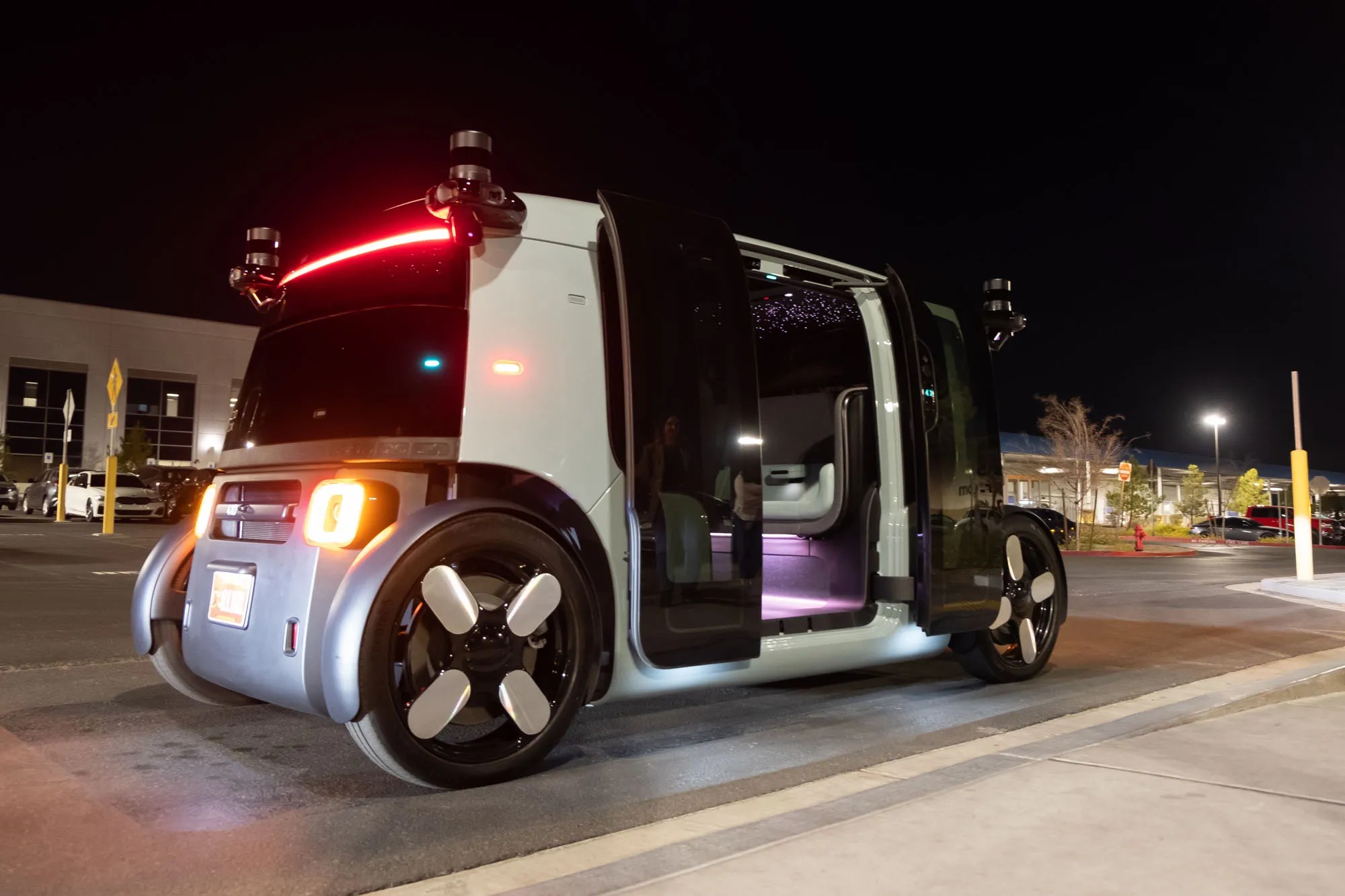
Zoox demonstrated notable progress with its autonomous robotaxi at CES 2025, offering select media rides along the Las Vegas Strip. The custom-built, electric robotaxi, lacking a steering wheel or human driver, handled complex scenarios like construction zones and car crashes with impressive competence, delivering smooth acceleration, confident lane changes, and minimal hesitation. While the rides felt safe and functional overall, there were moments of improvement needed, such as stiff suspension, abrupt braking, and less intuitive lane-merging in construction zones. These areas highlight the fine-tuning required before offering a premium and seamless rider experience.
Since its initial testing in 2023, Zoox has refined its robotaxi with hardware upgrades, enhanced software, and new features like a two-way audio interface for emergency communication. The company has expanded testing to include longer routes along the Strip, preparing for a public launch in Las Vegas and San Francisco later in 2025. Zoox’s ability to navigate real-world challenges safely underscores its readiness to transition to a commercial stage, potentially setting a new standard in autonomous mobility.
May Mobility

May Mobility unveiled an electric, autonomous minibus at CES 2025, developed in partnership with European bus manufacturer Tecnobus. Designed for urban transit, corporate campuses, and planned communities, the minibus can accommodate up to 30 passengers, including wheelchair users, and features swappable batteries to minimize downtime. Expected to join May's fleet of retrofitted Toyota Sienna shuttles in late 2026, the Tecnobus will expand the company's operations beyond its current U.S. markets and deployments in Japan, where it is already testing driverless shuttles and collaborating on autonomous vehicle pilots.
Mobileye

Mobileye showcased various technologies at CES 2025, including:
- ADAS Solutions: Enhanced by REM™ mapping for accuracy.
- Surround ADAS: Offering comprehensive safety with surround view.
- Mobileye SuperVision™: Hands-off assisted driving.
- Mobileye Chauffeur™: Consumer vehicle autonomy.
- Mobileye Drive™: Full self-driving for Mobility-as-a-Service.
It would appear investors were hoping for more developments from Mobileye (NASDAQ:MBLY) as stocks fell sharply after the press conference. As stated by MSN, "Some analysts expressed concern that the autonomous driving assistance software company did not provide any commercial updates, after having done so at last year's event."
Read More:
Infotainment / Display Tech
BMW Next Gen iDrive

At CES 2025, BMW showcased the future of in-car interaction with the debut of its next-generation iDrive system, set to roll out across all models by the end of the year. Building on concepts introduced with the i Vision Dee and Vision Neue Klasse prototypes, this advanced system integrates four key elements - BMW Panoramic Vision, a 3D Head-Up Display, QuickSelect central display, and a multifunction steering wheel - designed to work seamlessly together, for a more intuitive driving experience.
Panoramic Vision and 3D Head-Up Display
BMW’s Panoramic Vision projects key information onto a black strip spanning the windshield, allowing both driver and passengers to view customizable content. Critical driving data remains directly in the driver’s line of sight. Complementing this, the 3D Head-Up Display provides navigation and automated driving details exclusively to the driver, enhancing safety and focus by delegating non-essential information to the Panoramic Vision system.
QuickSelect Display and Multifunction Steering Wheel
The central display features matrix backlighting and customizable widgets for streamlined control, with the ability to transfer up to six widgets to the Panoramic Vision strip. The multifunction steering wheel incorporates haptic-feedback buttons that are subtly raised and illuminated for easy operation without taking eyes off the road.
Operating on BMW’s new Operating System X, which succeeds OS9, the system leverages an Android Open Source Project foundation to enable frequent updates and app integration. Voice controls are more natural, responding to complex requests like finding a charging station near a grocery store.
Read More:
Hyundai Mobis Immersive Displays

Hyundai Mobis showcased a groundbreaking full-windshield holographic display (HWD) at CES 2025, a major advancement in automotive heads-up display (HUD) technology. Unlike traditional reflective HUDs, the HWD uses multiple projectors beneath the dashboard and a special optical film embedded in the windshield, delivering brighter, more colorful images with shallower viewing angles. This ensures only occupants in the correct positions can view the content, adding a layer of privacy and precision.
The HWD, demonstrated in a Kia EV9, spans the entire width of the windshield and is divided into three zones: two for the driver and one for the passenger. It can display basic driving information, such as speed and navigation, alongside advanced 3D holographic maps that adjust in real time to aid navigation. The 1st-row passenger is meant to have a highly customizable in-car experience - they can cast content from a smart device, check vehicle information, or even play games.
Hyundai Mobis envisions the HWD as a complementary tool to traditional in-car displays, with potential for even larger versions covering the full windshield height. However, such implementations face regulatory hurdles in many countries. The company aims to begin production of the HWD by 2027 (following closely behind BMW’s upcoming panoramic HUD).
Read More:
